Knowledge Hub
Access current product manuals, installation information, specifications, data sheets and verified technical resources for Barrier Systems products.
Trusted Technical Information
Support Safer Projects
Build for Customers
Find Technical Information
Search manuals, data sheets, installation guides and more across our product range.
SHIELD I Product & Installation Manual
Product and installation information for the SHIELD I system.
SHIELD I Safety Barrier Technical Conditions for Use
Current technical conditions governing the accepted SHIELD I configuration.
Austroads Safety Barrier Assessment Panel – Accepted Safety Barrier Products
Austroads Safety Barrier Assessment Panel reference listing accepted safety barrier products and their assessed performance levels.
Explore Our Applications
Explore how Barrier Systems products support different site applications, from traffic and vehicle delineation to pedestrian guidance, work-area separation and temporary layout control.
Technical FAQs
Quick answers to common technical questions about Barrier Systems products, installation, specifications, testing and technical documentation.
Start with the job the system needs to perform. The range covers different requirements including tested vehicle containment, heavy-duty delineation, pedestrian separation, flexible connected layouts, straight continuous runs and low-profile temporary layout control.
If you know the application but not the model, use the Applications or Help Me Choose pathways. Where site conditions, traffic environment, run length or technical requirements affect the decision, Barrier Systems can help confirm the most appropriate option.
Rotational moulding is well suited to producing large, hollow and complex plastic forms such as water-filled delineators and barrier components. Barrier Systems uses the process across its current water-fillable range through the wider QSolutions manufacturing capability.
It also gives the business direct manufacturing knowledge rather than simply reselling generic imported products, supporting repeat production and project supply in Australia.
Yes. Barrier Systems is an Australian manufacturer based in Brendale, north Brisbane, and forms part of the wider QSolutions manufacturing group.
That manufacturing capability supports ongoing production, product knowledge and the ability to plan supply for both routine orders and larger project requirements across Australia.
Water-fillable systems combine practical handling with additional mass once deployed. The exact empty weight, fill capacity and filled mass vary significantly between models, which is why the range includes everything from compact portable systems to very high-mass delineation.
This allows the product to be selected around the real site requirement rather than assuming that one barrier size or weight suits every job.
They perform different safety functions. Products such as Aqua Stop, KI and TM systems are primarily used for delineation, separation, pedestrian guidance or layout control. They should not be assumed to provide tested vehicle containment simply because they are large or water-filled.
SHIELD I is the product in the current range intended for tested redirective vehicle containment in its documented configuration.
Yes. Project supply is an established part of the Barrier Systems business, including civil, infrastructure, council, industrial and reseller-led requirements.
For larger runs, the practical considerations usually include product selection, quantity, required length, delivery location, timing, freight and any accessory or configuration requirements. Barrier Systems can work through those factors before supply is confirmed.
Yes. Freight planning is a real part of larger barrier projects because the number of units, model dimensions, packing method and delivery location can materially affect the number of loads required.
Craig identified truck capacity, number of loads and freight cost as recurring customer questions. For larger requirements, Barrier Systems can work through the quantity and delivery details rather than leaving the buyer to estimate transport from product dimensions alone.
Barrier Systems has an established practice of sending damaged or unrepairable plastic barriers to external plastic recyclers in Brisbane, where the material is processed and repurposed into other products.
This is part of the company’s operating practice rather than a formal customer take-back programme.
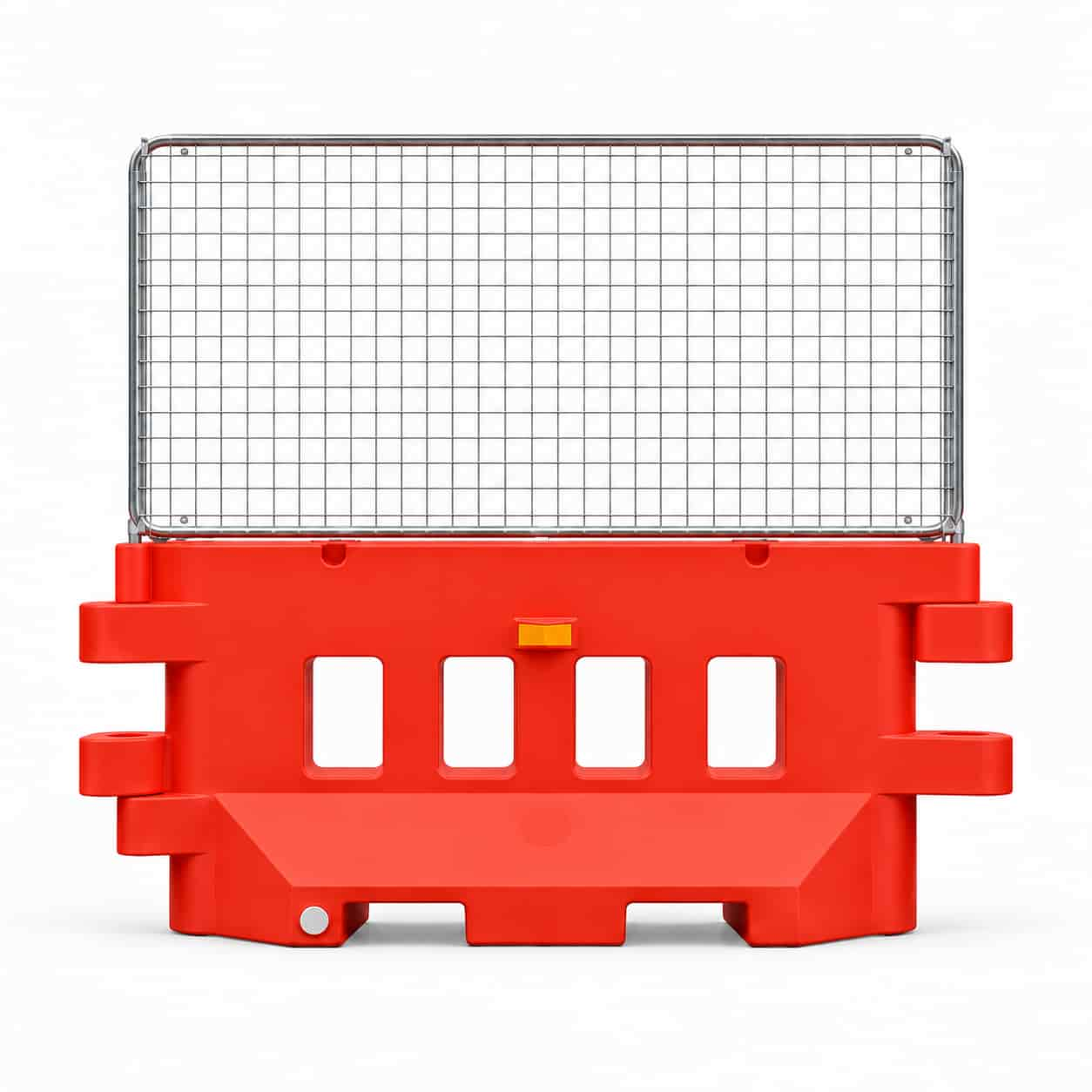
Some products in the range are designed with provisions for additional components such as mesh fencing, sign poles, lamps or other accessories, but compatibility varies by model.
For example, KI-1000 has documented provisions for fencing and other mounted accessories. Accessory requirements should therefore be checked against the specific product rather than assumed across the entire range.
Yes. Barrier Systems regularly supports product selection, technical confirmation, configuration, quantities, accessories and project requirements even where the final purchase is made through a reseller, distributor or established procurement supplier.
That means specifiers, project teams and procurement staff can come directly to the product source for technical guidance without needing to change their normal purchasing pathway.
A delineator defines a boundary and provides visual guidance. It is not selected for tested vehicle containment. SHIELD I™ is a temporary redirective barrier system intended to contain and redirect an errant vehicle when installed in its documented MASH TL1 configuration.
Although both categories may use plastic water-fillable units, their safety functions are different. Where a project requires high-mass visual delineation for longer or more exposed runs rather than tested containment, the Aqua Stop heavy-duty delineator may be the more appropriate product.
Redirective containment should be specified where the traffic-management or road-safety design requires an errant vehicle to be contained and redirected along a barrier rather than enter a work area or strike a hazard. A site being busy, exposed or associated with roadworks does not establish that requirement on its own.
First establish the required safety function. Then confirm that the documented speed, run length, lateral space, terminals, supporting surface and road-agency conditions can be accommodated.
Dynamic deflection describes the barriers sideways movement during impact. Working width describes the total lateral space occupied by the system during that movement. SHIELD I has a documented dynamic deflection of 2.20m and working width of 2.80m.
SHIELD I™ needs the full 2.80m working width to operate as documented. Planning around the 2.20m deflection alone understates the lateral space occupied during impact.
The current Austroads conditions specify a minimum installation length of 44m between terminals, while the tested article length is 52m. Neither figure is automatically the projects length-of-need.
Length of need is the site-specific barrier length required to shield the hazard. It depends on the hazard position, traffic approach, points of redirection and system layout. The required quantity should therefore be based on the assessed installation rather than the minimum length alone.
You can find our Austroads Safety Barrier Technical Conditions for Use PDF here: https://austroads.gov.au/__data/assets/pdf_file/0024/633480/240307-TCU-Shield-I-Safety-Barrier-System-Temporary.pdf
An accepted end treatment is required at both ends of every SHIELD I™ installation. The separate SHIELD I™ terminal units complete these end treatments and remain unfilled.
The SHIELD I™ terminal is gating and requires a traversable, hazard-free run-out area measuring 18.5m × 6m from the point of redirection. It should not be treated as a crash cushion or as part of the redirective longitudinal section.
SHIELD I™ suits temporary roadworks, lane closures and civil, infrastructure or utility projects where longitudinal separation beside live traffic requires tested redirective containment. It can separate the traffic path from a work area or roadside hazard when the documented system and site conditions can be met.
For road or lane closures, SHIELD I™ is arranged along the traffic path rather than across it as a roadblock. It is not an anti-ram device or crash cushion. A road, highway or roadside label alone does not establish suitability for the application.
The current Austroads conditions for SHIELD I™ document the following foundation pavement types:
- Concrete
- Deep-lift asphaltic concrete
- Asphaltic concrete over granular material
- Flush seal over granular material
- Unsealed compacted formation
The supporting surface must be smooth and free of snag points, kerbs or obstructions that could interfere with the system’s movement. Minimum support width and the effects of the site geometry require site-specific assessment.
The Austroads record issued 7 March 2024 lists SHIELD I as Recommended for acceptance at MASH TL1, with an accepted impact speed of 50 km/h. This recommendation is not blanket approval for every Australian road network.
Each road agency determines acceptance within its jurisdiction and may apply additional conditions. The relevant agency standards and project requirements should therefore be confirmed before SHIELD I is specified or installed.
MASH TL1 establishes the tested containment level, but it does not by itself confirm that a barrier system suits a particular site. SHIELD I™ performance must be applied within its documented system conditions, including the 50 km/h accepted impact speed, working width, dynamic deflection, connected length, terminals and clear zones.
The test level establishes the performance basis. The traffic environment, barrier layout, site conditions and road-agency requirements determine whether the complete system can be specified for the project.
The complete SHIELD I™ system consists of connected longitudinal pieces and SHIELD I™ terminals at both ends. The pieces interlock and are secured with a galvanised steel drop-in joining pin. This provides a substantially stronger mechanical connection for impact loads than the moulded-only interlocks commonly used to hold delineators or dividers in line. During a collision, the steel pin helps keep adjoining pieces engaged while allowing the controlled movement required by the redirective system.
The installation must also meet the technical requirements for connected length, terminal arrangement, working width, clear zones and site conditions. Together, these components and requirements form the documented MASH TL1 redirective barrier system. Using the correct pieces alone does not establish a compliant installation.
Aqua Stop combines a large overall format with a high fill capacity and substantial filled mass. Each unit holds 960L of water and weighs 1,020kg when full. At 2,105mm long, 1,060mm high and 600mm wide, it provides a substantial on-site presence for visual delineation and site separation.
- 960L fill capacity per unit
- 1,020kg filled weight
- 2,105mm long, 1,060mm high and 600mm wide
Aqua Stop is intended as a water-filled delineator for long runs and more exposed sites where greater filled mass is practically useful. Each unit contributes 2,000mm of effective length to the connected run, helping cover the required boundary with fewer individual units and connections. Once filled with 960L of water, each unit weighs 1,020kg, providing substantial on-site mass to help resist unintended movement. Separate drop pins form strong, secure connections between adjoining units.
- 2,000mm effective length per unit
- 1,020kg filled weight per unit
- Strong, secure drop-pin connection along the run
Site conditions, ground surface, layout and intended use should still be considered when confirming suitability.
When full, each unit holds 960L of water and weighs 1,020kg. This substantial filled mass helps the heavy-duty water-filled delineator resist unintended movement and stay put once the run has been correctly positioned and filled. Separate drop pins form strong, secure connections between adjoining units.
- 960L fill capacity per unit
- 1,020kg filled weight per unit
- Strong, secure drop-pin connections
Filled mass should not be treated as a tested movement- or wind-resistance rating. Ground surface, slope, run configuration, site activity and environmental conditions should still be considered when confirming suitability.
Each Aqua Stop unit has two top apertures for compatible mesh fencing, hazard lights or pole signage. These provisions allow additional visibility and site guidance to be incorporated along the connected run where required.
- Mesh fencing for a more continuous visual boundary
- Hazard lights for additional low-light visibility
- Pole signage for site information or directional guidance
Accessory compatibility, fittings and the complete configuration should be confirmed for the intended site use.
Yes. Linked into a continuous run, this water-filled delineator for roadworks can define temporary traffic routes, changed access points and active work-zone boundaries. Each unit contributes 2,000mm of effective length, while orange and white configurations and retroreflective tape help keep the route clearly identifiable.
- Define temporary or changed traffic routes
- Mark access points, work-zone boundaries and planned closures
- Extend visual delineation across larger roadwork areas
It can also be used as a water-filled road-closure delineator where the approved traffic-management plan requires visual guidance rather than tested vehicle containment. This water-filled traffic delineator is not crash-rated or redirective. Where tested containment is required, consider the SHIELD I redirective barrier system.
A water-filled civil works delineator can define active work areas, temporary site access routes, plant and equipment zones, material laydown areas and planned stage boundaries. Connected units form a substantial visual boundary for layouts intended to remain in place once filled.
- Define active civil and construction work areas
- Mark temporary site access routes and planned stage boundaries
- Visually separate plant, equipment and material laydown zones
Used as a water-filled worksite delineator, it provides visual delineation and site separation rather than tested vehicle containment. When selecting a water-filled delineator for civil works or a construction site, consider the ground conditions, run layout, site activity and required separation function.
The right worksite barriers depend on the function required. Where construction site barriers or temporary site barriers are needed for visual guidance, this heavy-duty water-filled delineator can define active work areas, access routes, plant and equipment zones and material laydown areas. Connected units form a substantial visual boundary for layouts intended to remain in place once filled.
- Mark temporary work-zone and construction-stage boundaries
- Define site access routes and work-area separation
- Visually separate plant, equipment and material zones
When comparing water-filled worksite barriers or water-filled barriers for construction sites, confirm whether the required function is delineation or containment. A water-filled temporary site separation barrier intended for visual guidance performs a different role from a tested traffic-containment system.
This product is not a water-filled crash barrier or water-filled redirective barrier. Where tested vehicle containment is required, consider the SHIELD I redirective barrier.
This heavy-duty water-filled delineator can form a substantial visual boundary for trenching, underground-services, utility-maintenance and infrastructure work areas. Connected runs can define temporary site routes and planned stage boundaries alongside drainage, sewer, stormwater, pipeline, pipe-laying and water-main works.
- Delineate utility excavations and active trenching areas
- Define temporary site routes and staged work boundaries
- Form longer connected lines along linear infrastructure works
Each unit provides 2,000mm of effective length and connects using separate drop pins, helping longer boundaries be formed with fewer individual units and connections. Once filled to 1,020kg, each unit provides substantial on-site mass where a more stationary delineator run is useful.
Its role is visual delineation and site separation. It is not trench shoring, excavation edge protection or a redirective vehicle barrier. Ground conditions, excavation setbacks, traffic environment, site layout and the required separation function should be considered when confirming suitability.
The displayed price supports straightforward online ordering. Where quantity, run length, timing or freight needs to be planned, Barrier Systems can prepare a project quote for Aqua Stop supply around the actual requirements.
- Required quantity or total run length
- Orange, white or mixed-colour requirements
- Required date and delivery location
- Site application and any suitability questions
Our Australian rotational-moulding capability allows project requirements to be considered alongside stock already on hand, production timing and freight planning. Availability and lead times depend on the order quantity, production schedule, destination and delivery requirements, so they should be confirmed for each project.
For quantity- or delivery-sensitive requirements, contact Barrier Systems with these details so current availability, the project quote and a practical delivery plan can be confirmed.
As a water-filled infrastructure works delineator, it can form connected visual boundaries around active work areas, temporary access routes and changing project-stage limits. Typical applications include:
- Trenching, excavation and underground-service works
- Drainage, sewer, stormwater, pipeline and water-main works
- Electrical and telecommunications installation, repair and maintenance
- Temporary access points and maintenance zones around public infrastructure
Used as a water-filled utility works delineator, it can mark work-zone limits, access points and maintenance areas where substantial visual separation is required. Its connected, high-mass format also suits planned layouts requiring a water-filled utility maintenance delineator or water-filled trenching works delineator.
When selecting a water-filled delineator for infrastructure works or a water-filled delineator for utility works, consider ground conditions, the traffic environment, access requirements, run layout and the required separation function. It provides visual delineation and site separation, but not excavation edge protection, fall prevention or tested vehicle containment.
The KI-1000 is suited to pedestrian separation and guidance, temporary walkways and footpaths, pedestrian detours, roadworks, construction and civil worksites, car parks and other low-speed areas where pedestrian movement needs to be clearly managed.
It is designed to create a connected pedestrian boundary, not for tested vehicle containment.
The KI-1000 is the larger and heavier option in the KI Series, with greater water-fill capacity and provision for mesh fencing.
It is particularly well suited to worksite and pedestrian-management layouts where a more substantial connected boundary or extended mesh fencing is required. The KI-900 is the lighter, more compact option where mesh fencing is not needed.
The KI-1000 provides for extended mesh fencing, hazard lights and pole signage through two openings on the top of each unit.
Mesh fencing can be used where a more defined pedestrian or worksite boundary is required, while lighting and signage can provide additional visibility and guidance for the layout.
The KI-1000 combines an interlocking modular design with water filling, allowing units to be positioned and connected before being filled on site.
Once filled, each unit weighs 387kg, giving the connected run greater mass for pedestrian and low-speed worksite layouts.
Yes. The KI-1000 can be used to define temporary pedestrian walkways, footpaths and detour routes where a connected delineator line is required.
Its interlocking design also allows the route to follow changes in direction rather than being restricted to a straight line.
The KI-1000 suits roadwork, construction, utility and civil sites where temporary pedestrian routes, work areas or restricted areas need to be clearly defined and separated.
Its larger format and provision for mesh fencing, hazard lights and pole signage make it particularly useful where a more visible and structured pedestrian-management layout is required.
Its interlocking system keeps adjoining units connected while allowing movement through angles of up to 120 degrees each way.
This allows connected runs to follow corners and changing pedestrian layouts without being limited to a straight line.
No. The KI-1000 is designed for pedestrian guidance, worksite delineation and clearly defined temporary routes in roadwork, construction and civil environments. Its provision for mesh fencing, hazard lights and pole signage can also improve visibility and help define pedestrian movement around the site.
Pedestrian containment means keeping pedestrian movement within a clearly defined route or area. It is different from vehicle containment, which requires a road safety barrier designed to contain and redirect a vehicle on impact.
The KI-1000 can be used in car parks, parking areas and other low-speed environments where pedestrian separation or a connected delineator boundary is required.
Its interlocking design is particularly useful where the layout needs to follow corners or changes in direction.
The KI-1000 is referenced against AS 1742.3-1996, Section 3.10.1(C), covering traffic control devices for works on roads.
The standard addresses the use of devices for guiding and managing road users and pedestrians around temporary worksites. The current edition is AS 1742.3:2019, so project-specific requirements should be checked against the latest standard before specification.
The KI-900 is suited to pedestrian separation and guidance, temporary walkways and footpaths, pedestrian detours, car parks and low-speed areas, and roadwork, construction or civil sites where pedestrian movement needs to be clearly managed.
It is a delineator for pedestrian and low-speed separation, not a system for tested vehicle containment or crash protection.
The KI-900 is the smaller and lighter model in the KI range, while both products are designed for pedestrian separation and low-speed applications.
The KI-1000 is the larger option and provides for mesh fencing. Where the KI-900 format suits the site and mesh fencing is not required, the KI-900 provides the same interlocking KI approach in a smaller unit.
No. The KI-900 does not provide for mesh fencing.
Where mesh fencing is required as part of the pedestrian-separation layout, the KI-1000 provides this option.
The KI-900 weighs 25 kg empty and can be filled with up to 270 litres of water, bringing its full weight to 297 kg.
This water-fillable design combines a manageable empty unit with substantially greater mass once filled.
Yes. The KI-900 can be used to define temporary pedestrian walkways, footpaths and detour routes. Its interlocking design allows connected units to follow changes in direction where the pedestrian route is not straight.
Length of need is the site-specific barrier length required to shield the hazard. It depends on the hazard position, traffic approach, points of redirection and system layout. The required quantity should therefore be based on the assessed installation rather than the minimum length alone.
The KI-900 can be used to help define pedestrian movement around a work area. Where vehicle containment is required, the SHIELD barrier system should be selected.
So yes, where the requirement is pedestrian separation, guidance or a temporary pedestrian route, this product is an excellent option.
The KI-900 uses an interlocking pin-and-hole system that allows connected units to move through angles of up to 120 degrees each way, making it a versatile option for curved or changing pedestrian layouts.
The KI-900 is a pedestrian and low-speed-zone delineator, not a crash or vehicle-containment barrier.
Where tested redirective vehicle containment is required, a system designed for that purpose, such as SHIELD I, should be considered.
Yes. The KI-900 is designed for low-speed environments and can be used in car parks and parking areas where pedestrian separation or delineation is required.
For parking-bay, line-marking or low-profile layout applications, another product in the Barrier Systems range may be more suitable.
The KI-1000 should be considered where a larger KI unit or mesh fencing is required. SHIELD I is designed for tested redirective vehicle containment, while Aqua Stop is suited to heavier high-mass delineation and the TM range covers more general-purpose and low-profile temporary layouts.
The installation must also meet the technical requirements for connected length, terminal arrangement, working width, clear zones and site conditions. Together, these components and requirements form the documented MASH TL1 redirective barrier system. Using the correct pieces alone does not establish a compliant installation.
The TM-700 is a general-purpose water-filled delineator suited to temporary site separation, pedestrian guidance and light-duty traffic delineation. Typical applications include civil and construction works, maintenance areas, car parks, venues and events, and other temporary layouts where a clear connected boundary is required.
It is intended for delineation and separation rather than tested vehicle containment.
The TM-700 is the stronger fit where the layout is predominantly straight and a longer continuous run is required. Each TM-700 provides 1,770mm of effective length, compared with 1,050mm for the TM-600.
The TM-600 is the better fit where the layout needs greater flexibility through curves or changing directions.
Each TM-700 contributes 1,770mm of effective length while using an interlocking connection between adjoining units. This allows longer straight delineator runs to be formed with relatively few individual units.
Its current product-fit role is straight continuous delineation rather than curved-layout duty.
The TM-700 weighs 10kg empty, making individual units practical to position before filling. Each unit holds 150 litres of water and weighs approximately 160kg when full.
This allows the run to be laid out while the units are light, then given substantially greater mass once positioned and filled on site.
Each unit provides 1,770mm of effective connected length and has an overall length of 1,910mm.
For estimating the number of units required along a connected run, the effective length is the more useful planning figure. Final quantities should still allow for the actual site layout, ends and any changes in direction.
Yes. The TM-700 supports accessory configurations including mesh fencing, lighting and signage.
These options allow the same delineator run to provide a more defined pedestrian or work-area boundary, additional visibility or site information where the application requires it.
Yes. Pedestrian guidance and work-area separation sit within the TM Series’ general-purpose delineation role, and the TM-700 can be used where a connected temporary boundary is required.
Where fencing is needed to create a more defined separation line, the TM-700 can also support a mesh-fencing configuration.
No. The TM-700 is an ordinary delineator for visual separation, pedestrian guidance and light-duty traffic delineation. It is not a tested redirective vehicle-containment system.
Where the requirement is to contain and redirect an errant vehicle, SHIELD I should be considered instead.
Aqua Stop should be considered where substantially greater filled mass and a more heavy-duty delineation format are required, particularly for longer or more exposed sites.
The TM-700 is positioned around practical general-purpose delineation and light empty handling; Aqua Stop occupies the higher-mass delineation role within the Barrier Systems range.
Choose the product around the required function. The TM-600 is the stronger option for flexible or curved delineation. TM-200 is better suited to low-profile, portable layout control such as parking and line-marking applications. Aqua Stop provides a heavier high-mass delineation option, while SHIELD I is intended where tested redirective vehicle containment is required.
The TM-700 is strongest where the requirement is a straight, continuous general-purpose delineator run with light empty handling and optional fencing or accessories.
The TM-600 is a general-purpose water-filled delineator suited to temporary site separation, pedestrian guidance and light-duty traffic delineation. Verified applications include construction sites, shopping-centre and car-park environments, sporting and event layouts, and smaller temporary jobs where a practical connected boundary is required.
It is intended for delineation and separation rather than tested vehicle containment.
The TM-600 is the stronger choice where the connected run needs to follow curves, corners or changing directions.
The TM-700 is better suited to predominantly straight, continuous runs and provides more effective length per unit. The choice therefore depends mainly on the geometry of the required layout rather than simply selecting the larger model.
The TM-600 uses an interlocking connection that allows adjoining units to form a connected run while changing direction.
Its shorter 1,050mm effective length also makes it better suited to layouts where the boundary needs to turn or adapt more frequently than a long straight run.
Yes. The TM-600 can be used with compatible mesh fencing where a more defined pedestrian or work-area boundary is required.
The fencing configuration should be selected and installed in accordance with the relevant product guidance and the intended site layout.
Each TM-600 weighs approximately 10kg empty, allowing units to be positioned and connected before filling.
Each unit holds 150 litres of water and weighs approximately 160kg when full. This allows the delineator to remain easy to handle before deployment while gaining substantially more mass once positioned and filled.
Each TM-600 provides approximately 1,050mm of effective connected length.
Its shorter effective length is useful where a layout needs more frequent changes in direction. For long predominantly straight runs, the TM-700 provides greater effective length per individual unit.
Yes. Pedestrian guidance and general work-area separation are part of the TM Series’ intended role.
The TM-600 is particularly useful where the pedestrian or worksite boundary needs to follow a curved, irregular or changing route rather than remain in a long straight line.
No. The TM-600 is a general-purpose delineator for visual separation, pedestrian guidance and light-duty traffic delineation. It is not a tested redirective vehicle-containment system.
Where the requirement is to contain and redirect an errant vehicle, a system designed and tested for that function, such as SHIELD I, should be considered.
The TM-700 should be considered where the requirement is primarily a long, straight continuous run. TM-200 is better suited to low-profile, portable layout control such as parking and line-marking applications. Aqua Stop is the heavier high-mass delineation option, while SHIELD I is intended where tested redirective vehicle containment is required.
KI products may also be more appropriate where pedestrian separation and highly flexible connected geometry are the primary requirement.
Its main practical distinction is the combination of light empty handling, water-filled deployment and a shorter connected format that is better suited to flexible or curved layouts.
That gives the TM-600 a different role from the TM-700’s longer straight-run format and the TM-200’s low-profile layout-control role.
The TM-200 is a low-profile portable divider designed for temporary layout control rather than conventional full-height delineation. It is particularly suited to car parks, parking bays, line-marking and maintenance zones, temporary route guidance and other layouts that may need to be established, changed or removed relatively quickly.
Its role is visual division and layout control, not vehicle containment or impact protection.
Choose the TM-200 where a low-profile, easily repositioned layout divider is the actual requirement.
The TM-600 and TM-700 are taller general-purpose delineators. The TM-600 is better suited to flexible temporary delineation, while the TM-700 suits longer straight continuous runs. The TM-200 serves a different role where a taller delineator is unnecessary and the priority is visible temporary layout control close to ground level.
Its proportions and intended job are different. The TM-200 is only 220mm high and is designed around low-profile division, portability and changing layouts rather than creating a conventional full-height delineator line.
Each unit is 1,100mm long, with 1,000mm of effective connected length and a 320mm-wide footprint. This compact format is what gives the TM-200 its distinct place within the Barrier Systems range.
Each TM-200 weighs approximately 4.5kg empty, allowing units to be handled, positioned and rearranged before filling.
Each unit holds approximately 40.5 litres of water and weighs around 45kg when full. This gives the product a useful combination of light empty handling and additional mass once the final layout has been established.
Yes. Temporary car-park layouts and parking-bay division are core TM-200 applications where the requirement is to create or alter a visible layout rather than install a permanent parking-control device.
It can be used to help define temporary bays, changed parking arrangements, circulation layouts and other visual divisions. It should not be confused with a wheel stop, parking lock, bollard, gate or other permanent vehicle access-control product.
Yes. The TM-200 is particularly relevant where line-marking, resurfacing, maintenance or layout changes require an area to be temporarily defined while work is carried out.
Its low-profile format and light empty weight make it practical where the layout may need to be established, moved or removed as the work progresses.
Yes. One of the TM-200’s strongest roles is temporary geometry and layout control where the arrangement may need to change before becoming permanent.
This can include temporary intersection or roundabout layouts, changed traffic or access paths, and other situations where a visible low-profile line helps establish the intended geometry without requiring a full-height delineator system.
Yes, where the requirement is temporary low-profile visual layout or route guidance and the site’s operational requirements permit its use.
The TM-200 has been identified for applications such as temporary taxiway or aircraft-stand guidance because its low-profile format can define a layout without performing the role of a vehicle-containment barrier. Site-specific aviation and operational requirements must still govern the final layout.
It can be used for low-profile visual pedestrian guidance where the objective is to indicate a temporary route or layout.
It should not be selected where the requirement is a taller physical pedestrian boundary, crowd-control system or mesh-fenced separation. In those cases, a KI product or another Barrier Systems system may be more appropriate.
No. The TM-200 is not a crash barrier, redirective barrier, vehicle-restraint system, wheel stop or permanent access-control device.
Its strength is almost the opposite: it is a low-profile, portable layout-control product for temporary visual division and changing geometry. Where tested vehicle containment, heavy-duty delineation, fencing or a taller continuous boundary is required, another Barrier Systems product should be selected.
Need Technical Confirmation?
If you need help confirming a technical requirement, product suitability or the right documentation for your project, our team can help.

STAY UP TO DATE
Get the latest product updates, project insights and industry news from Barrier Systems.

AUSTRALIAN MANUFACTURER

BUILT TO AUSTRALIAN STANDARDS

PROJECT & SUPPLY SUPPORT
Australian made barrier and delineation systems that protect people, manage traffic and keep worksites moving.
AUSTRALIAN MANUFACTURER
STANDARDS-AWARE PRODUCT GUIDANCE
PROJECT & SUPPLY SUPPORT


Barrier Systems is a brand of Q Solutions Co.
© 2026 Barrier Systems. All rights reserved.